Singapore’s healthcare system is under growing manpower pressure. The country is short thousands of nurses, yet frontline staff can still spend valuable time on tasks far removed from direct patient care, including counting supplies, checking stock levels and following up on replenishment orders.
That is why some of the most practical uses of AI in healthcare may not be happening in operating theatres or diagnostic rooms. They are appearing in quieter places such as storage areas, wards and supply shelves, where automation can potentially remove repetitive work from already stretched teams.
This shift is changing the question around healthcare AI. Instead of asking whether technology will replace nurses, a more useful discussion may be whether it can give them time back.
Singapore is estimated to be short around 3,000 to 4,000 nurses, while the Ministry of Health has projected a need for roughly 15,000 additional healthcare professionals by 2030.
In that environment, even small operational tasks matter. A 40-bed ward carrying around 120 different product types still needs someone to count supplies, track usage and ensure that essential items are reordered on time.
Individually, these jobs may seem minor. Repeated every day across wards and facilities, they can add up to hours of administrative effort that could otherwise be spent supporting patients.
That is especially relevant as healthcare organisations try to reduce burnout and make better use of limited manpower.
Much of the public conversation around AI in medicine focuses on advanced applications such as scan interpretation, diagnostics and clinical documentation.
But some of the nearer-term gains may come from back-office and operational systems that are easier to automate without changing clinical decision-making.
Singapore is already moving in that direction. The Ministry of Health has identified generative AI for routine documentation as one area where technology can reduce administrative workloads, while Budget 2026’s National AI Council has named healthcare as one of four sectors for a dedicated AI mission.
The emphasis is increasingly on augmenting workers rather than replacing them.
One area attracting attention is AI-powered inventory management.
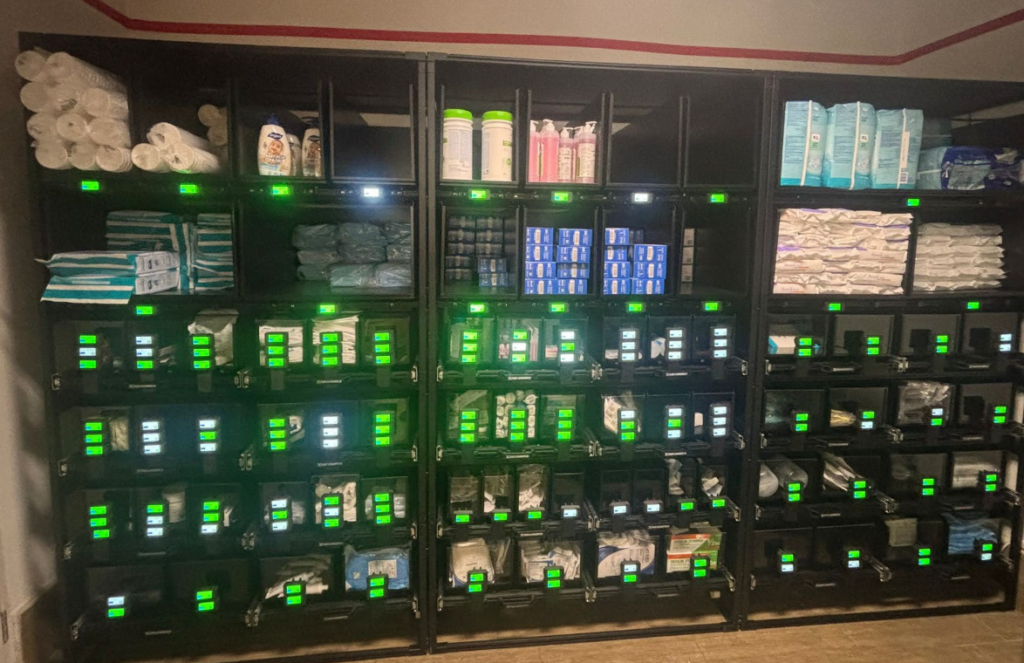
Singapore healthcare supply chain startup Flex Logistics has developed an AI Smart Rack that uses weight sensors to monitor medical supplies in real time. Instead of relying on manual counting, the rack can track usage down to individual items and detect changes in consumption.
Machine learning models then analyse these patterns and adjust replenishment thresholds automatically.
If one ward begins using more of a particular item, the system can increase the next top-up. If another product is moving slowly, replenishment can be reduced to prevent excess stock and unnecessary waste.
The basic idea is simple: the shelf itself notices what is running low before someone has to count it.
Traditional inventory management often depends on staff noticing that supplies are low, checking what remains and submitting a reorder.
Smart shelving changes that workflow by continuously monitoring stock levels and predicting when more supplies will be needed.
For healthcare facilities, this can reduce the risk of running out of essential items while also preventing overstocking. More importantly, it can remove repetitive tasks from nurses whose core role is patient care rather than inventory management.
Flex Logistics says one of its AI Smart Racks has been under pilot with a nursing home group linked to Singapore’s Ministry of Health for more than a year.
The trial reflects growing interest in using technology to improve healthcare operations before attempting more complex forms of clinical automation.
The founder of Flex Logistics, Jia Xiang Ang, has positioned the technology around workforce support rather than headcount reduction.
That distinction matters because many healthcare tasks still depend heavily on human judgement, physical presence and sustained interaction with patients.
AI may be able to reduce stocktaking, documentation and scheduling burdens, but it cannot replace the empathy, experience and situational awareness required in frontline care.
This makes healthcare a strong example of where automation may work best when it removes peripheral work rather than replacing core professional responsibilities.
For Singapore, where workforce shortages are already creating pressure, that approach may offer more immediate value.
AI should not be treated as a cure-all.
A smart rack cannot solve staffing shortages, improve every workplace culture or replace the emotional support that healthcare workers need during difficult shifts.
What it can do is remove one persistent layer of operational work.
That matters because burnout often comes from accumulation. When staff are responsible for patient care while also managing stock, paperwork and other routine duties, the administrative burden can slowly erode time and attention.
Reducing some of that load may create more space for workers to focus on the tasks that only people can do well.
As Singapore prepares for an ageing population and rising healthcare demand, workforce productivity will become increasingly important.
The most useful AI tools may not always be the most dramatic. In many cases, the biggest impact could come from solving mundane operational problems that waste time every day.
That is where inventory automation becomes more than a logistics story. It becomes part of a larger workforce strategy.
If AI can help nurses spend less time counting supplies and more time caring for patients, the value is not only operational. It is human.
Singapore’s healthcare sector is entering a phase where AI adoption will likely depend on whether technology can deliver clear, measurable benefits without weakening human oversight.
Systems such as smart racks show one practical route forward. They automate repetitive processes, improve visibility and support better planning while leaving clinical care firmly in human hands.
For healthcare providers, this may be the more realistic near-term future of AI: not replacing the people who care for patients, but removing the work that keeps them away from those patients.
Across Asia, healthcare systems are turning to technology to improve efficiency, strengthen workforce resilience and deliver better public outcomes.
RiseAsia covers the innovations, companies and ideas helping the region build more responsive and sustainable healthcare systems.
Discover more stories on health technology, workforce transformation and regional innovation at RiseAsia.
An AI Smart Rack is an inventory system that uses sensors and machine learning to monitor medical supplies, track usage and trigger replenishment automatically.
AI can reduce repetitive administrative tasks such as stocktaking, documentation and inventory monitoring, allowing nurses to spend more time on direct patient care.
Current policy direction in Singapore places greater emphasis on augmenting healthcare workers rather than replacing them. Tasks requiring human judgement, physical care and emotional connection remain difficult to automate.