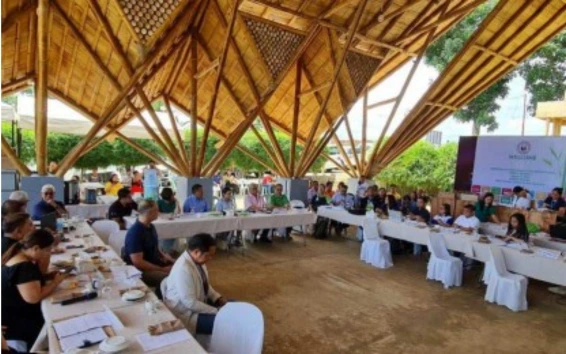

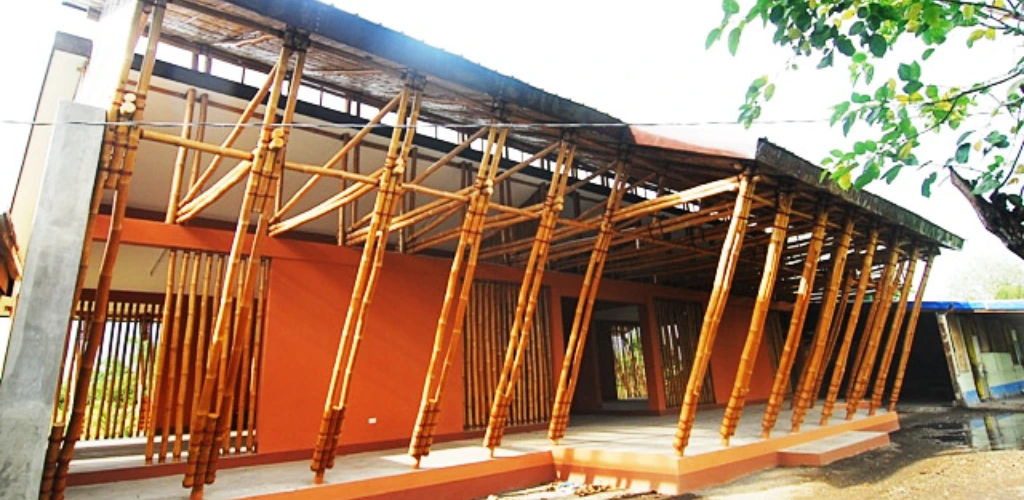
People thought bamboo was a thing of the past for a long time. It was linked to households in the country. Places to stay on the beach. Shelters for a short time. Steel and concrete became signs of progress. But that story is changing. Bamboo building in the Philippines is slowly becoming more important again, without making a lot of fuss. This time, it’s not about looking back. It’s about being useful.
The conversation is changing because costs are going up.
Prices of steel go up and down. The price of cement changes with global supply chains. Imported materials put more strain on costs, especially for small developers. Climate risks are also increasing tougher to ignore at the same time.
Typhoons get stronger. Flooding makes things hard for communities. The heat in cities gets worse. Developers, architects, and even local governments are starting to ask a different question:
What if we already have the answer?
The bamboo utilized in recent projects is not the same as the untreated poles that many people recall. Bamboo can be kiln-dried, chemically processed, laminated, and made into beams and panels today. It gets stronger, lasts longer, and is more consistent when it is processed correctly.
Some structural-grade bamboo products are now as strong as traditional materials when it comes to tensile strength. That doesn’t mean bamboo completely replaces concrete. But it does mean that it can accomplish more important jobs, such making structural frames, flooring systems, wall panels, and roofing support.
The material has changed. So has the business that goes with it.
Outside of the main cities, one of the most exciting things is happening.
Small and medium-sized businesses are starting to get involved in the bamboo supply chain. Some people are interested in farming. Some people put money into treatment centers. Some people are trying out prefabricated parts for low-rise homes.
Bamboo manufacture can happen in one place, unlike steel or cement.
It can be grown by farmers. They can treat and laminate it in the provinces. Designers can use it in projects that are close by. That makes supply chains shorter.
It also helps rural areas keep more of their wealth. If provinces want to diversify their local economies, the bamboo sector in the Philippines is a good place to start.
There is also an argument for resilience.
Bamboo can bend. Flexibility is important in places where earthquakes are common. Instead of breaking when pressure is put on it, it absorbs movement.
It is light, which lowers some structural concerns. And when it comes from a sustainable source, it has a smaller carbon footprint than heavier industrial products.
When building climate-resilient homes in the Philippines, the cost of materials is no longer the only thing to think about. They are about how long they will last and how much they will cost the environment.
That talk is getting louder and louder.
You can find bamboo in eco-resorts, especially in Palawan and Siargao. But its application is growing beyond only tourism.
Some schools and community centers in rural areas have added treated bamboo to their buildings. Some private builders are trying out hybrid designs that combine engineered bamboo upper structures with concrete foundations.
Architects are looking into how bamboo fits within the Philippines’ guidelines for green buildings. Younger buyers are more open to eco-friendly options than older buyers.
Still, adoption is still careful.
Building confidence takes time.
An industry can’t be formed just by interest.
The hardest things are size and consistency.
Not every area has a steady supply of bamboo. You have to spend money on treatment facilities. Certification and building codes are still not clear.
Another problem is getting money. A lot of small and medium-sized businesses in the sector don’t have much money to work with. It costs a lot to increase processing capacity.
Support from local governments also varies.
Some provinces have agricultural programs that encourage people to plant bamboo. In certain places, there isn’t much communication between farmers, processors, and builders.
Without alignment, growth stays broken apart.
If bamboo is going to go from being a specialized product to a mainstream one, institutions will need to adopt it.
People feel safer when bamboo is used in public buildings, even if it’s only a little bit. Standards become easier to understand. Engineers get more examples to work with. Developers get more at ease.
Policies for buying things can change the markets for those things faster than marketing campaigns can.
Private individuals and those that care about the environment are largely responsible for bamboo construction in the Philippines right now.
More support for policy would speed up growth.
Something else is going on too. Bamboo is something people know. The traditional bahay kubo is still a part of what it means to be Filipino. That heritage gives the culture a base that many other alternative materials don’t have.
Modern bamboo building is based on that knowledge. It mixes modern engineering with traditional ways of doing things.
That mix gives it narrative strength, not just the ability to be built.
Not all the time.
Bamboo that isn’t processed could be cheap. But modified bamboo products need to be processed, treated, and checked for quality. Costs might sometimes be the same as or even higher than those of traditional materials.
The true benefit is generally long-term sustainability and supply chains that are close to home, not just short-term savings.
Bamboo can be a good choice for low-rise buildings and certain architectural uses.
But it can’t be used everywhere.
It is part of a strategy for using different types of materials.
The Philippines’ cities are still growing.
There is still a need for housing. Infrastructure gets bigger. There are more and more tourism developments. Industrial areas are getting bigger. At the same time, people are expecting more from sustainability. That junction of growth and responsibility makes room for other options.
Building using bamboo in the Philippines fits inside that space.
It backs:
It also means something bigger: a willingness to reimagine what modern development looks like.
For bamboo to become a major part of the construction industry, a number of things need to come together:
More clear national norms.
More room for treatment.
Easier access to financing for small and medium-sized businesses.
Pilot projects that are easier to see.
None of these are impossible.
But they need to work together.
Bamboo’s momentum feels natural right now. People are becoming more interested. Things are coming up. Things are changing in conversations.
How carefully the industry moves from trying new things to planned growth will determine if it becomes mainstream.
Bamboo isn’t merely a symbol of the past in the country now.
It is coming back into the building debate as a practical way to deal with rising prices, climate change, and the need for sustainability.
The material is from the area. The talents are getting better. The interest is real.
If people in the sector and authorities are attentive and consistent, bamboo construction in the Philippines could become more than just a trend.
It might be part of the country’s long-term plan for building. And this time, it wouldn’t be going back to the past; it would be a stride toward a better future.
Discover more insights on Asia’s progress at riseasia.com.
Yes, when properly treated and engineered, bamboo can meet structural requirements for certain types of buildings. It is especially suitable for low-rise structures and hybrid designs combined with concrete or steel foundations.
Bamboo grows much faster than hardwood trees and absorbs carbon while maturing. It also requires less energy to process compared to steel or cement, which lowers its overall environmental impact.
It depends on the project. Raw bamboo is affordable, but engineered bamboo products involve treatment and processing costs. In some applications, it can be cost-competitive — particularly in low-rise or prefabricated designs.
During the Gaikindo Jakarta Auto Week, Changan formally unveiled the Lumin electric...
The technological shift wave is transforming the provinces surrounding Hanoi and Ho...
In the burgeoning digital world of Vietnam this March 2026, having a...
The Hyperboost Edge is a new running shoe from adidas that is...