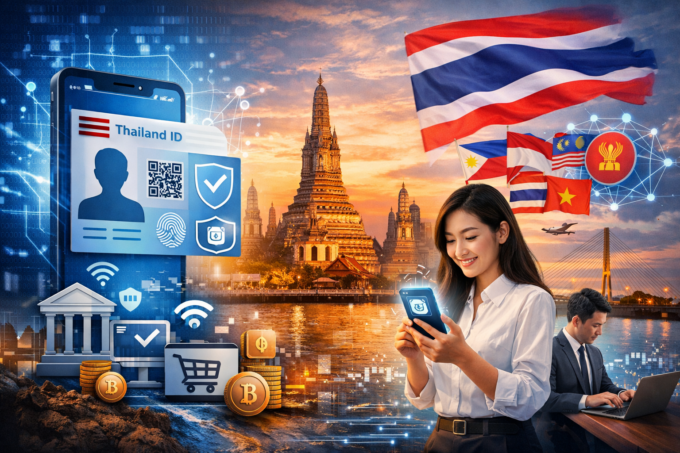



Thailand’s cross-border QR payment extension is another step toward the country’s goal of making digital banking more connected in the region. The Bank of Thailand (BoT) has formally linked its PromptPay system to another partner in ASEAN. This makes it easy for users and businesses to use their own banking apps to make QR payments across borders.
This new move builds on Thailand’s earlier QR ties with Singapore, Malaysia, Indonesia, and other countries. Thailand’s payment system is becoming one of the most advanced in Southeast Asia with each new integration.
The plan is more than just easy; it also has wider ambitions, like bringing in more tourists and making small and medium-sized firms more competitive in trade.
What Happened
The Bank of Thailand said that it was expanding its cross-border QR payment network to link PromptPay with the domestic real-time payment system of another ASEAN countries.
According to the plan:
- Thai people can use their local banking apps to scan QR codes when they are in other countries.
- People from other countries can pay for things in Thailand using their own country’s QR-enabled systems.
- Payments are made in the local currency, and the exchange rate is automatically changed.
Thailand’s PromptPay system, which started in 2017 as part of the National e-Payment Master Plan, is now one of the most popular digital payment systems in the area.
According to data from the Bank of Thailand, Thailand saw billions of electronic payment transactions each year in recent years. QR payments have become more and more popular among small businesses and street vendors.
This latest extension takes that ecology beyond its home country.
Why It Matters
Thailand’s cross-border QR payment strategy serves three major objectives: tourism facilitation, SME trade support, and regional financial integration.
Simplifying Tourism Payments
Tourism is still a big part of Thailand’s GDP. Before the pandemic, it made up a large part of the country’s income, and it has been steadily rebounding in recent years.
For tourism, cross border QR systems:
- Lessening the need to exchange cash
- Lower fees for transactions with other countries
- Make it easier to spend money
- Make retail and F&B transactions happen more often.
Digital payments in Thailand have already changed how people do business at home. Making that feature available to visitors makes Thailand a more appealing place to visit.
For small businesses that depend on tourism, such hotels, restaurants, and transportation companies, quicker ways to pay mean that money comes in more smoothly.
Facilitating SME Export and Trade
Small and medium-sized businesses are the most important part of Thailand’s economy. But a lot of small and medium-sized businesses have trouble with cross-border transactions because of hefty remittance fees and long wait times for payments.
Cross-border QR payment integration makes it possible to:
- Faster settlement for trades with modest amounts of money
- Less expensive to send money than typical bank transfers
- Better traceability and openness
For instance, Thai merchants who sell goods or services to their ASEAN neighbors profit from getting payment confirmation right away.
PromptPay ASEAN integration helps micro and small exporters who may not have access to complicated banking systems.
Strengthening Regional Financial Integration
The project fits in with ASEAN’s larger goal of making it easier for member governments to make payments to each other.
Central banks in Southeast Asia have been working together more and more to connect real-time payment systems. The goals of these projects are:
- Help trade between ASEAN countries
- Less reliance on international card networks
- Make financial independence stronger
Thailand’s fintech sector is a big part of this change. Thailand has one of the most developed QR infrastructures in the region, making it a natural link in the ASEAN payment connectivity network.
Industry Impact
Thailand’s digital economy is implicated from the expansion of cross border QR payments that carry multi layered.
Growth of the Fintech Ecosystem
The integration encourages fintech innovation by:
- Encouraging banks to improve their mobile payment systems
- Supporting infrastructure that works across borders via APIs
- Making new chances for financial services that use data
Fintech companies can use the rise in the number of transactions to provide services that offer value, like credit scoring, financing for small and medium-sized businesses, and cross-border e-commerce solutions.
Thailand’s digital payments industry has already reached a lot of people in the country. Regional expansion opens up a new area for growth.
Lower Transaction Costs
Traditional cross border payments often involve multiple intermediaries, resulting in:
- High fees
- Delayed settlements
- Currency conversion complexity
By using the QR system this will reduce the friction allowing direct back to back transfer through platforms.
This benefits small traders and informal businesses that previously relied on cash or costly payment channels.
Formalization of Informal Trade
One under-discussed impact is formalization.
Digital payment trails improve:
- Financial transparency
- Tax reporting accuracy
- Access to credit
As more transactions move through traceable systems, SMEs gain stronger credit profiles, enabling access to formal financing.
This shift strengthens Thailand’s broader digital economy framework.
Challenges and Operational Risks
Cross-border QR payment systems still need to consider about a few problems, even though things are getting better:
- Keeping track of how exchange rates fluctuate
- Cybersecurity risks
- Keeping customer information safe
- Bringing interoperability standards into line
For smooth settlement and to cut down on fraud, it is very important for the countries who are taking part to work together on regulation.
The Bank of Thailand still highlights how important it is to have security measures in place and make sure they are in line with those of other central banks.
Future Outlook: Toward a Seamless ASEAN Payment Network
It’s unlikely that the Thailand cross-border QR payment plan would stop at bilateral agreements.
Policymakers in the region want to create a bigger payment network that covers all of ASEAN, that allows to:
- People who travel can easily do business across borders.
- SMEs can get paid right away
- Settlements give priority to local currency.
As ASEAN digital trade grows, payment connectivity becomes a basic part of the infrastructure.
The growth may also help with the following in the future:
- Growth of e-commerce across borders
- Speeding up the recovery of regional tourism
- More access to money in developing countries
Digital payments have changed how people do business in Thailand. The next natural step is regional integration.
Why This Signals Broader Digital Transformation
Cross-border QR payments are vital for more than just making things easier.
It shows:
- Have faith in the maturity of digital infrastructure
- A vow to work together to improve the region’s economy
- Moving faster to cashless payments
Thailand has slowly gone from utilizing paper to handling real-time domestic transfers. The country moves up in Southeast Asia’s digital economy by sending that skill to other countries in the area.
As trade, travel, and services become more digital, being able to pay in a variety of ways gives you an edge over your competitors.
Conclusion
Thailand’s expansion of cross border QR payments represents more than a technical upgrade, but it is a strategic economic move.
By linking PromptPay with additional ASEAN partners, the Bank of Thailand enhances tourism convenience, supports SME trade, and deepens regional financial integration.
As digital ecosystems expand, seamless payments will become essential infrastructure for Southeast Asia’s growth story.
Thailand is not just participating in that transition, it is helping shape it.
Stay updated with the latests trends and insights in Thailand by exploring more articles on RiseAsia.