
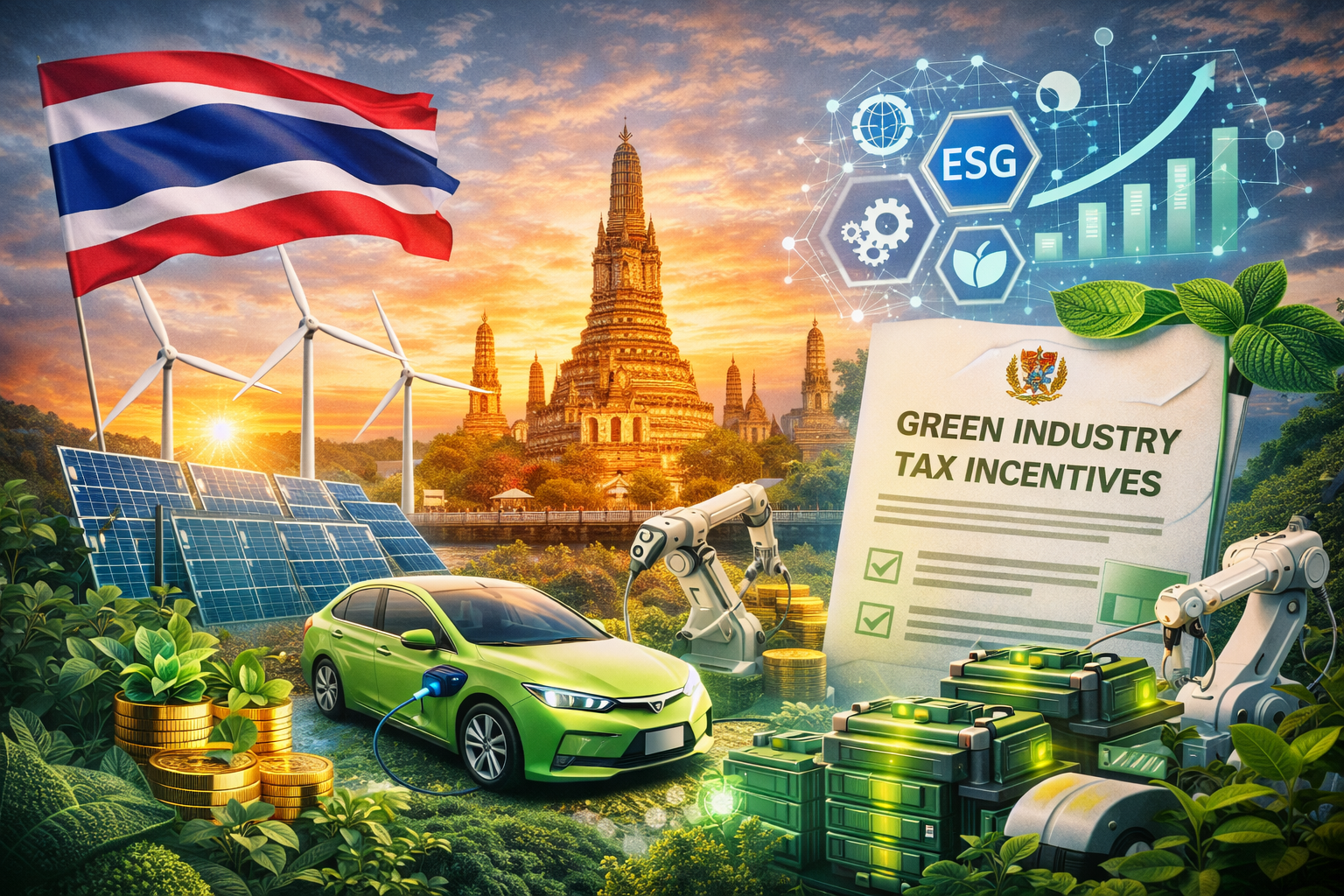

Thailand’s green industry incentives are a big step toward bringing back the country’s status as a regional hub for sustainable manufacturing. The government has approved a new set of tax breaks for projects that use renewable energy, make parts for electric vehicles (EVs), and make things with low carbon emissions.
The policy shows that Thailand’s strategy has changed: following environmental rules is no longer optional; it is now a key part of the country’s industrial competitiveness.
What Happened
The Board of Investment (BOI) is part of the government. It gave businesses that invested in the following things better corporate income tax breaks and lower import duties:
- Creating and storing clean energy
- Building batteries and other parts for electric vehicles
- Changes to manufacturing that use less energy
- Technologies that cut down on carbon emissions
- Steps for a circular economy
Projects that meet the requirements can get longer tax breaks, faster depreciation allowances, and more tax breaks for investments in sustainability.
The incentives are for businesses that use measurable carbon-reduction frameworks, which fits with Thailand’s bigger plans to change its industries.
The move is in line with Thailand’s Bio Circular Green (BCG) economic model and adds to the incentives that are already there to make electric cars and clean energy.
Why It Matters
The European Union’s Carbon Border Adjustment Mechanism (CBAM) is one of the biggest reasons why Thailand is offering green industry incentives in 2025.
The EU has started to slowly add carbon taxes to imports of steel, aluminum, cement, fertilizers, and other goods that produce a lot of emissions. Thailand is a major exporter to Europe, and if local manufacturers don’t cut emissions, the cost of compliance will keep going up.
Exports make up more than 60% of Thailand’s GDP, and the EU is still an important trading partner. Thai exporters could be in danger if they don’t make green improvements to their businesses:
- Costs of complying with carbon laws are going up.
- Less competitive prices
- Possible changes in the supply chain
The government wants to protect Thailand’s position as an exporter by encouraging low-carbon production at home.
Supporting Thailand’s Net-Zero 2050 Commitment
By 2065, Thailand has promised to stop putting carbon dioxide and other greenhouse gases into the air.
A lot of the emissions in the country come from factories and other businesses. So, it’s important to speed up sustainable manufacturing in Thailand to keep long-term climate promises.
The incentives show that people know that making industry less carbon-intensive needs money and clear rules, especially for big changes like adding renewable energy and making production systems electric.
Attracting ESG-Driven Foreign Investment
Investors around the world are putting more and more importance on following environmental, social, and governance (ESG) rules. Multinational companies are being pushed to cut carbon emissions from their supply chains, especially in the electronics, automotive, and consumer goods sectors.
By making its industrial policy more focused on sustainability, Thailand makes itself a more appealing place to visit for:
- Companies that make electric vehicles
- Companies that make semiconductors
- Developers of renewable energy
- Investors in green hydrogen and batteries
More and more countries in ASEAN are competing for this kind of capital, and Malaysia, Vietnam, and Indonesia are all pushing for green industrial strategies.
Thailand’s move shows that it is serious about staying in charge in the region.
Industry Impact
Surge in BOI Applications
Industry observers expect an increase in BOI investment applications, particularly in:
- Solar and wind power installations
- Battery and EV parts manufacturing
- Industrial energy-efficiency retrofits
Recent years have already seen rising renewable investment Thailand commitments, especially in solar power capacity expansion.
The new incentives could accelerate private sector participation further.
Industrial Estate Transformation
Thailand’s biggest industrial estates, especially those in the Eastern Economic Corridor (EEC), are likely to get upgrades to their green infrastructure.
Developers might combine:
- Solar systems on the roof
- Managing the smart grid
- Ways to store energy
- Systems that turn waste into energy
Industrial zones that offer low-carbon certification may attract more investors, which would make Thailand more competitive.
Higher ESG Compliance Standards
The policy also makes things harder for manufacturers in the US.
To stay in global supply chains, businesses must increasingly offer:
- Disclosures about carbon footprints
- Goals for using renewable energy
- Documents for sustainable sourcing
This may raise short-term compliance costs, but it strengthens long-term positioning.
Financial institutions are also making their lending standards more in line with sustainability benchmarks, which makes the transition even stronger.
Economic Context
Thailand’s manufacturing sector contributes significantly to GDP and employment, particularly in automotive, electronics, petrochemicals, and making food.
The production of electric vehicles is growing quickly, thanks to the EV 3.0 and 3.5 incentive packages that came before it. Solar power is now a bigger part of the energy mix, and renewable capacity has also grown.
But as the economy gets better and digital infrastructure grows, the demand for energy in industry keeps going up.
So, finding a balance between growth and cutting emissions has become a major policy challenge.
The Thailand green industry incentives for 2025 are an effort to make sure that economic growth goes hand in hand with caring for the environment.
ASEAN Green Manufacturing Hub
The longer term ambition is clear which positions Thailand as ASEAN’s green manufacturing hub.
To achieve this, several developments are likely:
Corporate Renewable Power Purchase Agreements (PPAs)
More industrial firms are expected to enter long-term renewable energy contracts to stabilize energy costs and meet ESG targets.
Expansion of Low-Carbon Supply Chains
EV production, battery recycling, and clean electronics manufacturing could expand further under supportive policies.
Cross-Border Green Trade Alignment
Thailand may deepen collaboration with ASEAN neighbors to harmonize sustainability standards, strengthening regional integration.
Challenges Ahead
Even though the incentives are good, there are still implementations that will determine impact.
Key risks include:
- Infrastructure bottlenecks
- Skilled labor shortages in green technologies
- Capital constraints for SMEs upgrading equipment
- Policy continuity concerns
Clear regulatory guidance and streamlined approval processes will be essential.
Conclusion
The Thailand green industry incentives for 2025 are more than just a change in taxes; they show that things are going to work differently.
Because of global carbon rules, changing investor expectations, and competition from other countries, Thailand is making its industrial strategy more eco-friendly.
If done right, the incentives could:
- Make sure exports are competitive
- Get FDI that cares about ESG
- Invest more quickly in renewable energy.
Strengthen Thailand’s role in ASEAN’s growing green economy.
We’ll find out in the next few years if the country’s policy goals can really help businesses and make it the leader in sustainable manufacturing in Southeast Asia.
Stay updated with the latests trends and insights in Thailand and Asia by exploring more articles on RiseAsia.